

 Company
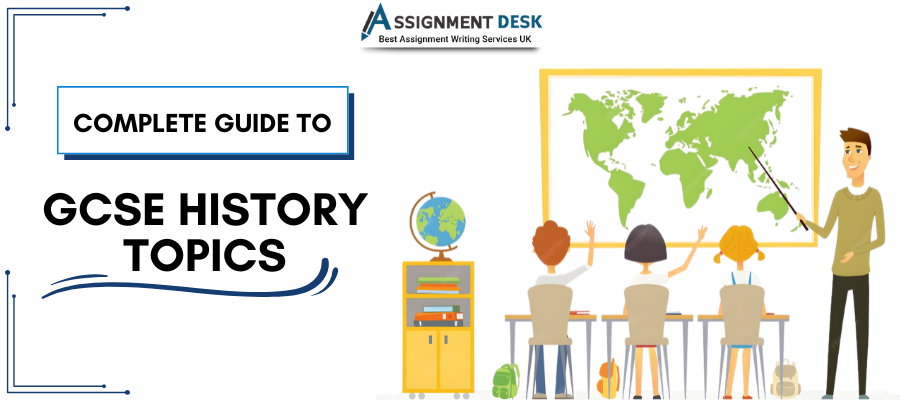
GCSE History Topics: Exam Boards, Study Areas, and Key Focus
Explore GCSE History topics, key study areas, exam boards, and question types for exams.
21 Feb 2026
4961


Explore GCSE History topics, key study areas, exam boards, and question types for exams.
Table of Content
Key Components of GCSE History Topics
Study Areas Covered By GCSE History Topics
GCSE History Cases Across Key Exam Boards
What Types of Questions Should You Expect in GCSE History Exams?
Are you struggling with GCSE History? If yes, there is no need to worry. We understand that exam preparation involves studying a wide range of topics and concepts. However, the syllabus you follow mainly depends on the exam board, as each board allows schools to choose different content to teach. For instance, Edexcel offers 17 topic options for schools to select from. This limited choice often makes it difficult for students to identify a topic that meets their learning needs. Below is a clear breakdown of the main board such as AQA, Edexcel, OCR, WJEC/Eduqas and CCEA. Additionally, you will also learn what types of questions to expect in GCSE history exams and how to prepare for them. Let's begin.
GCSE history is a school-level history that helps you know vital events, people and changes from the past. Further, it focuses on how societies formed over time and why some events had a lasting effect. Through this subject, you learn to determine causes, consequences and several perspectives using historical evidence.
As one of the popular history subjects, GCSE History also builds key skills like critical thinking, essay writing and source study. Further, you can study a range of periods and themes, depending on the exam board, which helps them gain a broad learning of national and global History while preparing for further studies.
GCSE history covers a broad range of time periods to help you know how people, societies and ideas have evolved over time. Further, by studying several eras, you learn how past events have shaped the world we live in today. The main historical periods usually studied include:
This period looks at life in the Middle Ages. These topics may add events such as the Norman Conquest or several crises, such as the Black Death. Further, these studies help you know early British and European society.
In this era, you discover key changes in religion, politics and culture. Further, topics often have the Renaissance, the Reformation and the English Civil War, which brought vital changes in control and trust.
This period focuses on more recent situations such as the Industrial Revolution, the World Wars and the Cold War. Further, these topics help you see how modern nations and global relations formed.
This structure makes GCSE History revision topics simple to follow and helps you build a clear learning of the past step by step. Additionally, to support suitable and original work, using a free plagiarism checker UKcan help you review tasks confidently and handle academic integrity.

Get Your GCSE Assignment Delivered in 3 Hours!
 Scan me Scan me
GCSE history is divided into clear study areas that help you know several aspects of the past. Further, these areas focus not only on events but also on how societies changed, how power was used, and how people's lives were affected. Also, exploring these areas helps you develop strong knowledge and exam skills.
This area looks at how countries were governed and how power changes over time. Also, you study rulers, governments, laws and key political events such as revolutions, reforms and wars. Further, it helps determine how decisions made by leaders impacted nations and people.
It focuses on daily life in the past. You learn about living conditions, health, education, work and the role of several social groups. It helps you know how ordinary people lived and how society changes across different periods.
These areas explore how money, trade and industry grow over time. Moreover, topics may include farming, industrial growth and changes in employment. You learn how economic changes impact society and living standards.
You study key wars, battles and conflicts. It includes learning about causes of wars, key events and their effect on countries and civilians. Further, it covers how warfare changed over time.
This area focuses on relationships between countries. Further, topics often add alliances, peace treaties and global conflicts such as the Cold War. Also, it helps you know how international decisions shaped world history.
You discover beliefs, traditions and cultural movements. It adds studying religion, art and ideas that impacted people's views and actions in different periods.
Overall, these study areas offer you a balanced learning of History. Further, by covering politics, society, economy, conflict and culture, GCSE History helps learners see the past from various perspectives and prepares them well for exams. Further, for you who need expert guidance, online assignment help UK can offer clear support, expert explanations and organised assistance to enhance learning and exam performance.
History GCSE topics range from exam boards, but they all focus on one critical event, themes and skills that are a must for the exam. Plus, this section marks History GCSE cases and the common 10 History topics taught by major exam boards.
AQA GCSE history is broadly categorised into thematic, period, in-depth world, and British study depth, which are as follows:
1. Thematic Study: Examines how a particular theme, like crime, power, medicine or warfare, changes and develops across a different period of time, more often 1000 years. It mainly focuses on:
Here is an example of a prominent GCSE history thematic study:
2. The Period Study: Covers a specific historical period in detail, probably a few decades or up to a century. It particularly examines the key events, people, ideas and developments within that specific time, instead of a long theme across centuries.
3. The In-Depth World Study: Focuses on a specific country, region or event in the wider world over a shorter, concentrated period. It examines the causes, events and significance of major historical developments in that area.
4 . The British Study Depth: Allows students to investigate one area closely, examining causes, consequences and significance that took place in Britain.
On a similar note to the above, Edexcel GCSE History is divided into three studies:
1. The Period Study: Covers the time span of 50 years, during which you learn the development and the problems that happened at that time.
2. The Thematic Study lets you know about the changes and continuity over a long period of history. Here, you focus on a particular historical site.
3. The British Depth Study: It focuses on a short span of British history, which requires you to understand all the relevant social, economic, political, religious and military factors.
OCR GCSE history is broadly categorised into four studies, which are as follows:
1. Thematic Study: is a long period of history where you will read for change and continuity. The broad topics are:
2. British depth study: Allows you to explore a country that is in danger of invasion and that is as follows:
3. Period Study: Involves studying a time span of 50 years, where one learn with respect to developments and the respective issues.
4. The World Depth Study: Helps you know better all the key historical and societal circumstances.

Stuck with your Assignment?
Hire our PROFESSIONAL ASSIGNMENT WRITERS and Get 100% Original Document on any Topic to Secure A+ Grade
Get Assignment Help
GCSE history exams include several query types to test knowledge, learning and analytical skills. Further, knowing what kind of questions to expect helps you plan your solutions and manage time accurately during the exam.
All these questions test basic knowledge and learning. You may be asked to explain an event, person or key aspect using clear points.
You must analyse historical sources such as photographs, letters, cartoons or extracts. Further, you explain what the sources show, how useful they are and how suitable they may be.
These questions ask you to determine the causes, consequences or importance of events. Further, clear reasoning and suitable samples are critical.
You compare two periods, events or perspectives. Further, you develop arguments, support them with facts and reach a clear conclusion.
GCSE history exams are designed to test a range of skills, from recall to evaluation. Further, by practising each question type, you can enhance confidence and perform better in exams. Further, if you want detailed answers for your exam, you can seek our online exam help services.
This blog on GCSE History topics ends here. We hope it has helped you understand what to focus on while revising for your exams. However, writing GCSE assessments takes a lot of time and effort, and many students still find it hard to get high marks. Now is the right time to improve your results. At Assignment Desk, our skilled experts are ready to help you write a strong and well-organised GCSE History paper. You can trust our professionals to handle tasks like write my assignment and reduce your stress. Contact us today and move closer to better grades.
Read more - LEAPS Model of Communication for Clear Interpersonal Interactions
Boost Grades & Leave Stress
Get A+ Within Your Budget!
Use Our FREE TOOLS !
Limited Time Offer
Exclusive Library Membership + FREE Wallet Balance
1 Month Access !
5000 Student Samples
+10,000 Answers by Experts
Get $300 Now
 Update your Number