When we talk about modern change management in business and other management-related programs, the Bridges Transition Model often comes as a key framework that students learn about. Mainly to understand why employees resist change and how organisations can promote long-term adaptation among them. It is one of the most widely used frameworks which helps in guiding organisations and individuals through changes by majorly focusing on the emotional and psychological process instead of just the operational or technical aspect of it. As a management student, knowing about this model can help you in analysing real workplace changes, designing strategies, and applying practical solutions in your case studies or assignments.
What is the Bridges Transition Model?
To go more deeply into it, the Bridges Transition Model is a change management framework which follows a three-stage process to help individuals and organisations effectively lead groups and employees through times of change. It was developed by William Bridges and first introduced in 1991.
And for more than 35 years, many organisations, leaders, and management consultants have been using the William Bridges Model of Transition to understand the human side of change. The core idea of the model focuses on the internal psychological transition people go through at times of organisational change, instead of the external situational change. The key distinction in this includes:
- Change: Situational (new job, new policy, new system)
- Transition: Psychological (how people emotionally adapt)
On one hand, change is something that can happen instantly. But transition, on the other hand, is a slow process and is an emotional journey that people need to navigate to get used to their new reality. Once the manager addresses this emotional journey, it gets much easier for them to link the goals of the organisation with the readiness of the employee.
(Convergent Strip)
(H1) Need Help With Management Case Studies?
(p) Learn how the Bridges Transition Model works and get assignment help from professionals.
What is the Difference Between Transition and Change?
Before we move further, it is really important for students to understand the difference between transition and change when completing assignments on change management. This is regardless of whether they are using an assignment writing service for guidance or working on it independently.
Even though they usually occur together, change and transition are two different things. On one hand, Change is the outside event. This can be a new strategy, a merger, a new leader, or a new product. It is about what needs to happen and usually happens quickly.
Transition, on the other hand, is the inside process. Meaning, how people mentally and emotionally adjust to the change. It is about leaving the old ways behind and getting used to the new situation.
For change to really work, leaders need to first focus on helping people through the transition. And not just pushing the change. Supporting employees this way keeps morale up, helps them adapt, and creates stronger, more resilient teams.
What are the Key Stages of Transition?
The Bridges Change Model follows a three-stage process or phases that individuals need to go through. These include:
1. Ending, Losing, and Letting Go
2. The Neutral Zone
3. The New Beginning.
Below is a more detailed overview of these three stages:
Ending, Losing, and Letting Go
The first stage of the Bridges Model of Transition is ending. This starts when individuals learn about the new change and is generally met by resistance and, at times, emotional upheaval. But in order for the transition to work, the individuals first need to accept the ending of old ways of work, behaviours, routines, roles, and relationships. In this stage, they may get confused and become uncertain about the new ways of things.
- Key Emotions:Fear, denial, anger, sadness, confusion, frustration, and a feeling of loss.
- Leadership Task:Openly recognise what people are losing, accept their resistance as natural, and support them as they adjust to leaving the old ways behind.
The Neutral Zone
After people let go of the first stage, they enter the in-between or the neutral zone. This zone often has similar elements to the first stage but is more inclined towards uncertainty, confusion, or impatience. In this in-between stage, while the old ways of working are no longer there, the new ways are not fully formed.
Due to this, individuals can feel confused, which can in turn lead to low productivity and anxiety. They might question their role and doubt whether the change will actually lead to positive outcomes.
- Key Emotions: Impatience, scepticism, confusion, and sometimes curiosity.
- Leadership Task: Communicate clearly and frequently, set short-term goals to keep progress moving, and encourage people to test new ideas and approaches.
The New Beginning
The final stage of the Bridges Transition Model is a new beginning, which is marked by a release of new energy and acceptance from the team. In this, individuals adopt a calmer and much more positive attitude towards their new roles and identities. In this stage, the leaders need to clearly explain what the new beginning will involve and then reassure the team that there will be a better direction and stability.
- Key Emotions: Energy, confidence, enthusiasm, and acceptance.
- Leadership Task: Support the transition with proper training, celebrate early successes, and adjust systems and rewards to encourage new behaviours.
How to Apply Bridges Transition Model for Change Management?
To effectively apply the William Bridges Transition Model, leaders can follow the steps mentioned below based on different stages:
Stage 1: Ending, Losing, and Letting Go
In this stage of the transition, leaders will have to address the initial emotional reaction (fear, denial, and anger) of the team/group. To do this, they need to:
1. Acknowledge What is Changing: Try to be clear about what the people are actually losing, which can be their everyday routines, responsibilities, or status. Then acknowledge their emotions.
2. Explain the Reason: Explain why the change is happening, what exactly will change, and what will remain the same.
3. Create Closure: Mark this transition with a symbolic or meaningful action or event to help people move forward.
Stage 2: The Neutral Zone
In the neutral or the in-between period, prepare the employees for the shift. To do this, you can:
1. Create Clear Directions: Set short-term goals like 30, 60, or 90-day targets in order to provide employees with stability and to keep the progress on track.
2. Support Trial and Learning: Give the employees the freedom to test new ways of working and let them learn from mistakes.
3. Strengthen Communication: Conduct daily or regular check-ins and feedback sessions for better communication and reduced confusion. This will help in maintaining the team morale.
Stage 3: The New Beginning
In this last stage employees accept their new identities, roles, and the change completely. In this stage, leaders need to:
1. Clearly Explain the 4 Ps: Make sure that everyone understands the Purpose (why the change is happening), the Picture (what the next step or the future will look like), the Plan (steps for how it be achieved), and lastly their Part (what they are needed or required to do).
2. Celebrate Progress: In the initial stages, make sure to acknowledge early achievements and reward any employee behaviour that supports the new direction.
3. Make It Stick: Lastly, reinforce the “new normal”. To do this, try to update KPIs, policies, systems, and the onboarding processes to reflect any change.
Bridges Transition Model Example
Let's take a look at an example to understand this Bridges Transition Model in a practical way:
Case Scenario: Bank Merger and Organisational Restructuring
During a merger of two banks, the change in its organisational structures, such as the systems, branding, and hierarchy, often happens quickly. However, it can take some time for employees to adjust well to it. Using the Bridges Model, we can explain how the leaders can step-by-step manage this human side of change:
Stage 1: Ending, Losing, and Letting Go
- What Happens:Employees find out and realise that their old routines, roles, and autonomy are disappearing.
- Leadership Response:As a response, the senior leaders of the banks hold meetings to acknowledge what is ending openly and address the concerns of the employees.
- Purpose:This will help the staff emotionally accept that their previous way of working is over instead of ignoring feelings of loss or resistance.
Stage 2: The Neutral Zone
- What Happens:Confusion between the employees increases as the old system no longer works. And at the same time, the new structure is not fully operational because of which the productivity takes a dip.
- Leadership Response:To deal with this, the bank runs parallel systems for 90 days and introduces “decision clinics” to guide managers through unclear responsibilities.
- Purpose:This will stabilise the performance of employees, reduce uncertainty, and support them through the adjustment phase.
Stage 3: The New Beginning
- What Happens:In the end stage, the employees start adapting to the new structure and expectations.
- Leadership Response:The CEO launches a unified brand identity (“One Bank”) and connects incentives to new behaviours.
- Purpose:This builds commitment, restores morale of employees, and creates a shared vision for the future.
Criticisms & Limitations of Bridges Change Model
While the framework of William Bridges Transitions is widely celebrated and used by organisations around the world. There are many who highlight its limitations. As a business and management student, it is extremely important to know about these:
1. Lack of Structured Process: It does not provide any guidance on how to measure progress, track how well people are adopting the change, or use numbers to evaluate performance.
2. Narrow Focus: The model focuses too much on emotions, which can, at times, miss the real business issues. Additionally, it often ignores the culture, market conditions, and leadership influence.
3. Oversimplifies Human Complexity: It also works on the assumption that people move through different stages in a single order, which is not always true.
4. Scalability & Resource Issues: This model works best for small teams, but for larger organisations, it can get harder.
5. Depends on Leadership Skill: Last but not least, it needs the leaders to have high emotional intelligence in order to guide the teams properly.
(Convergent Strip)
(H1) Struggling to Analyse Real-Life Examples?
(p) Our team provides easy-to-understand, ready-to-use Bridges Transition Model examples for your assignments.
Bridges Transition Model Comparison with Other Change Models
The Bridges Model of Change is a bit different from traditional change models like John Kotter's 8-Step Model or Kurt Lewin's 3-Step Model. This is because it focuses more on the emotional journey people go through. Here's a quick comparison of it with other models:
- Kotter's 8-Step Process:Kotter gives a top-down, step-by-step plan for change, while Bridges focuses on how individuals feel and adapt.
- Prosci's ADKAR Model:ADKAR helps people with Awareness, Desire, Knowledge, Ability, and Reinforcement, but Bridges zooms in on the emotional phases of letting go and moving forward.
- Lewin's Change Model:Both have three stages, but Lewin looks at organisational structures, while Bridges looks at how people experience the change mentally and emotionally.
- Kubler-Ross Change Curve:Like Kubler-Ross, Bridges tracks emotions, but it maps them to Endings, Neutral Zone, and New Beginning instead of the five stages of grief.
As a student, when writing your management assignments especially on frameworks like the Bridges Transition Model, it gets extremely important to maintain quality and originality. And to do this, you can use a number of tools like:
- Reference Managers:There are tools like Zotero or Mendeley which can help you organise your sources and generate citations automatically. This can in turn save your time and reduce errors.
- Note-Taking and Organising Apps: Applications like Evernote or OneNote can make it easier for you to structure your research and keep track of key points for your assignment.
- Grammar and Writing Assistants:Grammarly or Microsoft Editor can help you polish your writing, correct mistakes, and improve clarity.
- Plagiarism Checker:Lastly, you can use a reliable and free plagiarism checker UK to ensure your work is original, properly cited, and academically sound before submission.
Conclusion
In short, the Bridges Transition Model is a handy framework that helps organisations and leaders guide employees through the emotional side of change. For students, it's great for explaining how people react to change in management assignments and case studies. It shows why employees might resist, the stages they go through, and how leaders can support them. Using this model makes your work more practical and shows you understand the human side of change. If you want a little extra help with your management assignments, then Assignment Desk can guide you in applying the model effectively and ensure your work is clear, accurate, and assignment-ready.



 Company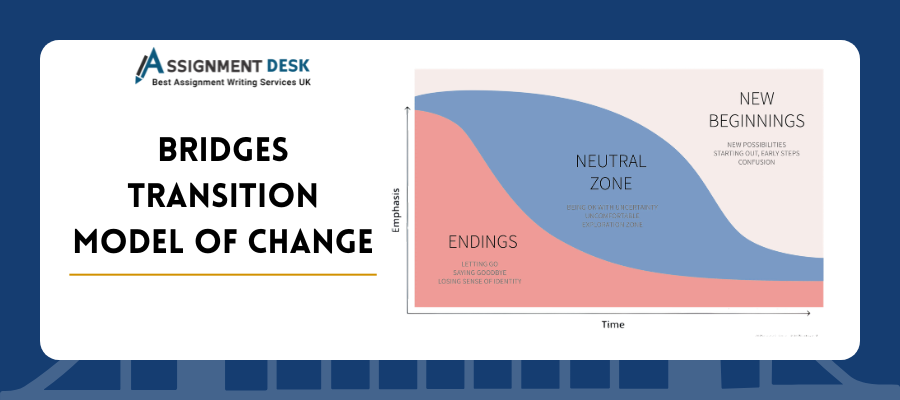









 Update your Number