Writing a dissertation can be quite daunting, especially if you are unsure about what topic you want to write about. In this case, your dissertation proposal is a good first step to take. It helps in showcasing the area of study, the significance of the subject you have selected and the approach you will use in doing the research. Learning how to write a dissertation proposal helps one come up with an idea that can be turned into a research agenda, which is further analysed by the supervisor before undertaking the actual dissertation work.
What Is a Dissertation Proposal?
A dissertation proposal is a brief plan of study that is written before the main dissertation itself. The proposal highlights your topic of research, its significance, the questions related to your research, and how you will conduct your research. The purpose of this plan is to help you figure out if your project is manageable within course requirements, available resources and deadlines.
Think of it as a roadmap instead of a summary of the research you have already done. You are describing what you plan to study, not the results of your work.
Different universities, departments, and subjects have a specific style that varies from one to another. Some proposals need you to include a complete literature review and methodology in your work, while in some cases, you only need an outline. You should always consult your module handbook and your supervisor about your topic before writing.
How Is a Dissertation Proposal Different from a PhD Research Proposal?
The proposal of an undergraduate or master's module is usually intended to show that you know your topic well enough and can do the research. The PhD research proposal has a completely different function.
It is normally included in a doctoral application and has to show the novelty, academic value, and long-term prospects of the research.
Module dissertation proposal
PhD research proposal
Concerned with an easily manageable undergraduate or master's level research
Contributes to a major doctoral research project
Shows knowledge of the subject matter and techniques involved
Shows originality and potential for knowledge creation
Abides by the dissertation guidelines of the department
Complies with doctoral application or funding criteria
Typically timed with a taught course submission date
Can involve a longer research period
Struggling to Shape Your Dissertation Proposal? Get Subject-Matched Expert Support From Topic to Timeline Stand Out
A dissertation proposal is not simply another piece of academic paperwork. It helps you work out whether your research idea is worth pursuing and how you can approach it without becoming overwhelmed.
Here is why it matters:
Makes your research objective clear: You define the problem that you want to study and decide what your dissertation is going to be about.
Conveys your knowledge of the subject matter: Your preliminary literature review proves that you are familiar with the existing body of research.
Enables your supervisor to evaluate feasibility: By putting forth your methodology, questions of investigation and time frame, you provide your supervisor with more information as to what you are going to undertake.
Helps to identify problems: You can identify any possible difficulties pertaining to participation, data collection, resources or ethics at an early stage.
Makes a workable plan: Your proposal acts as a guide for you in structuring the dissertation.
A good proposal does not ensure that your research will proceed as expected. Rather, it provides a rational base and makes it easier to change your approach when needed.
How Long Should a Dissertation Proposal Be?
There is no one-word count standard for dissertation proposals across all UK universities for undergraduate and master's students.
This is why the single word count does not apply to every course.
You may have specific guidelines that include a maximum number of words, or that require a certain format of proposal or sections that need to be included. Some proposals are fairly short, while others need more information regarding literature and methodology.
To avoid problems before writing your proposal, you should:
Refer to the module handbook and dissertation proposal briefing paper.
Check whether the word count includes references, tables or appendices.
See if an abstract or research summary has to be provided.
Find out whether your tutor expects any additional information.
Consult whether the department has got any templates for proposals.
What Is the Structure of a Dissertation Proposal?
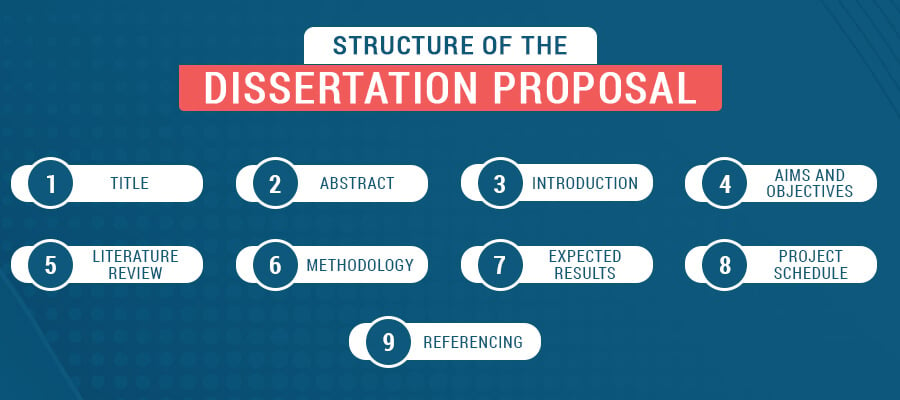
While the structure for writing a dissertation proposal will differ from one institution to another and from one field of study to another, there is a common format that is followed. Every part of the proposal serves to illustrate your research idea and its significance to your work. You can also build a skeleton for your own project with our free dissertation outline generator.
Working Title
A good title needs to capture the central idea of your project without getting too technical. Make sure that you incorporate your subject, group, or relationship under study whenever applicable.
For example, the title ‘The Relationship Between Remote Working and Employee Productivity in UK Small Businesses' is more descriptive of what you are aiming to find out than ‘Remote Working and Productivity' for those reading the proposed research.
Consider the title tentative for now. You can modify it after you have narrowed down your research question and objective(s).
Introduction and Background
This section provides an overview of the research topic that you are investigating. You should begin by providing some context around the topic. Then narrow down into the specific problem that your dissertation is looking to investigate.
Give a brief statement as to why your topic is important and what we know and don't know from previous research. You need to justify your proposal well but without going into too much depth. For more on opening your project well, read our tips for an engaging dissertation introduction.
Research Questions, Aims and Objectives
A research question tells what you want to look at. The aim and objectives will tell you what you're trying to achieve and help you break the aim down into smaller research tasks.
For example, if your project is looking at remote working, you may look at the experiences of employees, their perceived issues with productivity and how they compare with findings from previous research.
These should link together to ensure your research has a clear focus.
Literature Review
This section shows your understanding of the current literature. Here you should identify key themes, results and areas of debate.
This will help show what has already been found in previous research and where further research could be useful. This can help justify why your research question is a good one to look into.
Methodology and Research Design
Outline how you will answer your research question. Identify any relevant research methods and designs. Describe what data you will be using and how you will collect it. Describe what analysis you will do.
For example, interviews could be used to understand employee experiences and questionnaires to identify trends.
Your research methodology should be appropriate for your research question and available resources.
Ethical Considerations
Identify potential ethical issues. If there are people involved in your research, then explain how you will get informed consent, ensure their confidentiality and how you will handle the data.
Ensure that you meet any university requirements and gain ethical approval if needed.
Expected Outcomes and Limitations
Explain how your research will contribute to understanding certain things. You should also identify any limitations of the research such as limited access to participants, a small sample size or a limited time frame for the research.
Timeline
Outline the main stages of your research project. This should include a literature review, developing your methodology, ethical approval, data collection, analysis and writing.
You may want to allow for some time to receive feedback from your supervisor and account for any delays.
References
List all the academic references you have used in your proposal. They should be presented using the referencing style your university has requested. Ensure that all of your citations are listed and are formatted correctly. A free referencing tool can help you format them.
How to Write a Dissertation Proposal in 6 Steps
If you divide writing your dissertation proposal into sections, you can make the task more manageable. Here are 6 steps to help you form a clear, specific and realistic proposal:
Identify your research topic
Ensure your topic relates to something that interests you and fits within your academic discipline. Look into academic and recently published sources to identify topics for research.
Think about:
What your specific research topic will be
Who/what are you going to research (population, organisation or material)
Your academic setting
How much time/resources you have available
What the requirements of your dissertation are
Ensure your research topic is interesting, specific and manageable.
Develop a Clear Research Question
Formulate a clear question which can be researched. What exactly do you want to know, and can this be investigated in your dissertation?
Aim to avoid questions which cover multiple unrelated topics. Discuss your proposed question with your supervisor.
Review Relevant Literature
Use academic texts, peer-reviewed articles and reliable sources. Identify key findings, research methods used, theories and limitations of previous research. Identify gaps in the research which will help to justify your chosen research.
Define Your Research Aims and Objectives
Outline what you are aiming to achieve with your research in general terms and state 2 or 3 objectives that will help you achieve this.
Each objective should clearly relate to your research question.
Choose Your Research Methodology
Choose appropriate methods for your research. Think about what kind of data you need to collect (primary, secondary or both). Outline how you will collect and analyse your information. If you are using people in your research, think about how you will find them, gain access and obtain ethical approval and consent. Your methodology should show that your project can be completed with the resources you have available.
Plan Your Timeline and Review Your Proposal
You will need to produce a realistic timescale for each stage of the research process, including data collection and analysis, writing up and editing.
Ensure that your research proposal is coherent. The question and objectives should be linked to the literature review and research methods. In addition, you should ensure that ethical issues are addressed. Speak to your supervisor about your draft and amend any areas required.
Stuck on Your Research Question or Methodology?
Work With an Expert Who Knows Your Subject and Referencing Style
In this example, you can see how you might approach your dissertation proposal. Here we have included the key parts of the proposal within the structure above. This is an example only and cannot be used to carry out research, nor can it be used as your own proposal.
Research Proposal Title
The Relationship Between Social Media Use and Academic Productivity Among Undergraduate Students
Introduction and Background
Social media is commonly used by students within Universities to communicate, access learning materials and plan their academic work; however, it may cause distractions.
The research aims to identify how undergraduate students at an identified University in the UK perceive social media use and its relationship with their academic productivity.
Research Question
How do undergraduate students at a chosen university in the UK interpret the impact of social media on their academic productivity?
Research Aim and Objectives
Aim - To investigate how undergraduates interpret the impact of social media on their academic productivity.
Objectives
To identify the usage levels of social media by students.
To investigate how students interpret their usage of social media in relation to academic activity.
To identify what factors students associate with being productive or unproductive whilst using social media.
Literature Review
The literature review will focus on academic research surrounding social media, student engagement and academic productivity.
Findings regarding whether social media can be a distractor and how it can provide educational benefits will be compared. Furthermore, how productivity has been defined in previous research and students' experiences will be explored.
This will highlight any relevant findings, assess how research has been conducted in previous studies and provide justification for the current study.
Methodology
For this research, a qualitative research methodology will be used.
Design - The study is a small-scale interview study.
Participants - Approximately 8 to 10 adult undergraduate students aged 18 or over from a chosen university in the UK.
Sampling - Participants will be recruited using an appropriate sampling process approved by the university.
Data collection - Semi-structured interviews will be conducted to find out information about participants' social media usage and academic experiences.
Analysis - Thematic analysis will be used to identify patterns.
This study will look into participants' perceptions rather than causation.
Ethical Considerations
Ethical approval will be sought from the institution. All participants will be provided with study information, consent to take part after being informed of what they are consenting to, and all will participate voluntarily.
Personal identifying information will be kept safe. Research data will be stored safely. Participants will be informed of their right to withdraw.
Expected Outcomes and Limitations
This study can give insight into the experiences of students regarding social media, for example, how it can create distractions, help with communication and organisation of their academic work.
However, the sample is small and only one university has been used, meaning the results would be limited. The findings would show what the participants believed rather than proving social media causes changes in academic productivity.
Research Timeline
A 12-week research schedule will include preparation, ethical approval, recruitment, interviews, analysis, writing and revision, subject to university deadlines.
References
The final proposal will include references using reliable academic sources relating to social media, academic engagement, qualitative research and thematic analysis. The references will follow the referencing style required by the university.
Choosing a Broad Topic: If your topic is too broad, you may struggle to create a specific research question. Try to narrow your topic down.
Unclear Research Question: Your research question needs to be clear about what you are looking to investigate and can be answered using the methods you have proposed.
Descriptive Literature Review: Within your literature review, you should provide some analysis on the relationship between the studies, along with any differences and limitations.
Inappropriate Methods: Ensure your method of research matches the question you're trying to answer. Do not choose a method simply because they seem familiar.
Overlooking Ethics: If your project needs ethical approval, then get it before carrying out any relevant research.
Unrealistic Objectives: Do not make exaggerated claims about the results of your research, such as saying that your small sample size proves a wide-ranging theory or represents the whole population.
Confusing Outcomes with Findings: Clarify what you aim to find instead of displaying the results that have not yet been collected.
Poor Timeline Planning: Plan out your research schedule to see if any issues will occur and to ensure you complete each part in enough time.
All things considered, before learning how to write a dissertation proposal, you need to think about your research question and plan realistically. The key is to have a clear link between your objectives, literature review and methodology. You should also consider ethical issues, resources and time frames. Moreover, always refer to your university guidelines and discuss your draft proposal with your supervisor. Having a well-planned proposal will give you a solid basis for your dissertation and provide a good starting point.
A dissertation proposal explains what you intend to research, why the topic matters and how you plan to investigate it. It helps your supervisor assess whether your project is academically relevant, manageable and suitable for your course.
How Long Should a Dissertation Proposal Be?
Dissertation proposal length varies by university, department and academic level. Check your module handbook for the required word count and structure. If no guidance is provided, ask your supervisor before deciding how much to write.
Is a Dissertation Proposal the Same as an Abstract?
No. An abstract briefly summarises a completed or proposed piece of research. A dissertation proposal is a research plan explaining the topic, rationale, questions, methods and intended approach before the main research begins.
What Should a Dissertation Proposal Include?
A dissertation proposal commonly includes an introduction, research questions, aims and objectives, literature review, methodology, ethical considerations, expected outcomes, timeline and references. Your university may require additional sections or a different structure.
Can I Change My Research Question After My Proposal Is Approved?
You may be able to revise your research question, but significant changes should be discussed with your supervisor. Changes affecting methodology, participants or ethical approval may require further review before you continue.
Do I Need Ethical Approval for My Dissertation?
Ethical approval depends on your research and university requirements. Projects involving human participants or personal data may require review before data collection. Discuss your proposed study with your supervisor and follow your institution's ethics procedures.
Choose a writer for your task among hundreds of professionals
Try Before You Buy !
Get Free PDF Link Directly to your WhatsApp!
Great!!Sumsa Free PDF Template has been delivered on your
WhatsApp Number.
Please rotate your device
We don't support landscape mode yet. Please go back to portrait mode for the best experience
We use cookies to ensure that we give you the best experience on our website. If you continue to use this site we will assume that you are happy with it. Know more



 Company













 Update your Number