How to Write a Reflective Essay: Step-by-Step Guide with Models & Example
How to Write a Reflective Essay: Step-by-Step Guide with Models & Example
Learn how to write a reflective essay in six steps, compare Gibbs, DIEP, Driscoll and Rolfe, and see two worked examples for UK university assignments.
Have you ever reflected on an experience you have gone through in the past and found out that there was more to learn than you initially believed? It is this kind of experience that will form the foundation of your reflective essay. Learning how to write a reflective essay requires you not just to narrate events, but to analyse your choices and actions, comprehend what has led to certain events and find out what lessons can be learned from them. The guide covers the writing process, discusses different reflective models that are prevalent, and gives some examples that may help students.
What Is a Reflective Essay?
A reflective essay is an example of academic writing, where you analyse your experience, draw some lessons from it, and consider its effect on you. This experience may be connected to a university assignment, teamwork, internship, work-related event, or even a personal one, or even one related to your studies.
While in an essay you would discuss your topic using arguments and facts, in reflective writing you need to make a connection between your experience and analysis. You will not only explain what took place but also its importance and what you have learned from it.
The components of a good reflective essay include:
Description: Briefly describe the event and give adequate background information such that the reader understands it.
Analysis: Analyse your actions, perceptions, emotions, and the influences behind them that led to the outcome.
Relate it to Academic Theory: Use an academic concept in the analysis of the experience.
Lesson Learned: Mention what you have learned from the experience and what you will do differently in the same situation in the future.
Struggling With Tough Essay? We've Got Your Back!
Order Today and Enjoy Smooth, Hassle-Free Help From Experts
What Is the Difference Between a Reflective Essay and a Reflective Report?
A reflective essay and a reflective report share common characteristics since they discuss experiences and the lessons learned from those experiences. However, their structures and intentions might not be alike.
Reflective essay
Reflective report
Typically creates a connection between the discussion and the experience.
Use of clearly labeled sections to respond to specific tasks, events, or learning outcomes.
Usually creates paragraphs to make analyses and connect experience with scholarly theory.
Adherence to a specific template or headings in report writing.
Focuses on critical reflection, interpretation and personal development.
Combination of reflective elements with an activity/learning-based approach to writing reports.
These are broad distinctions rather than absolute. Some institutions define the two differently, and thus your brief determines the required structure.
In case you need to write a reflective report in particular, then consider using a reflective report guide rather than writing an essay.
Which Reflective Model Should You Use?
Reflective frameworks enable one to analyse an experience logically. The use of the framework will take you from the description of the experience to its significance and on to how you can use the lessons from it.
When picking your reflective framework, consider first your assignment specifications. It might be that your lecturer has indicated the framework for a subject such as nursing or education.
Gibbs' Reflective Cycle
Gibbs' Reflective Cycle is a cycle that was designed by Graham Gibbs in Learning by Doing (1988). It has six stages, which include the following:
Description: What happened?
Feelings: What were you thinking and feeling?
Evaluation: What worked well or badly?
Analysis: Why did it happen that way?
Conclusion: What else could have been done, and what was learned from the experience?
Actionplan: What will be done if the same situation arises again?
This model is ideal in instances where an assignment calls for an intensive reflection of experiences involving emotions, reasons and possible ways of improvement. In cases where learners are required to conduct their reflections using a set format, it becomes very useful.
DIEP Reflective Framework
The DIEP approach stands for Describe, Interpret, Evaluate and Plan. This model provides a four-step framework for analysing an experience and then applying the learning gained from the experience.
Describe: Determine the experience or the insight which led to the reflective process.
Interpret: Explain its meaning and relate it to prior learning, theory, or the literature.
Evaluate: Assess its worth and impact on your learning.
Plan: Discuss how you plan to apply this learning in future situations.
This approach could prove especially useful in an academic reflection assignment when one needs to highlight the development of knowledge over a course or a specific task.
So what? Consider its meaning and implications, what you have learned from it and the significance of that lesson.
Now what? Point out the action you are going to undertake.
The simplicity of Driscoll's reflective model makes it applicable whenever one has to make a brief analysis of a certain incident; yet you would still have to dig deeper into the reasons behind your actions and link the outcomes to related knowledge.
Rolfe's Reflective Framework
The reflective framework was developed by Rolfe, Freshwater and Jasper using the same three fundamental questions: What? So What? And Now What? The framework enables the writer to explain the experience, analyse its significance and reflect on the way forward.
This framework has much relevance to the field of professional reflection, especially nursing and other practice subjects. Even though the framework bears some similarities with that of Driscoll, their respective methods of publication are quite different in terms of origin and prompts. You should follow the terminology and citations that your course recommends rather than making them synonymous with each other.
How to Write a Reflective Essay in 6 Steps
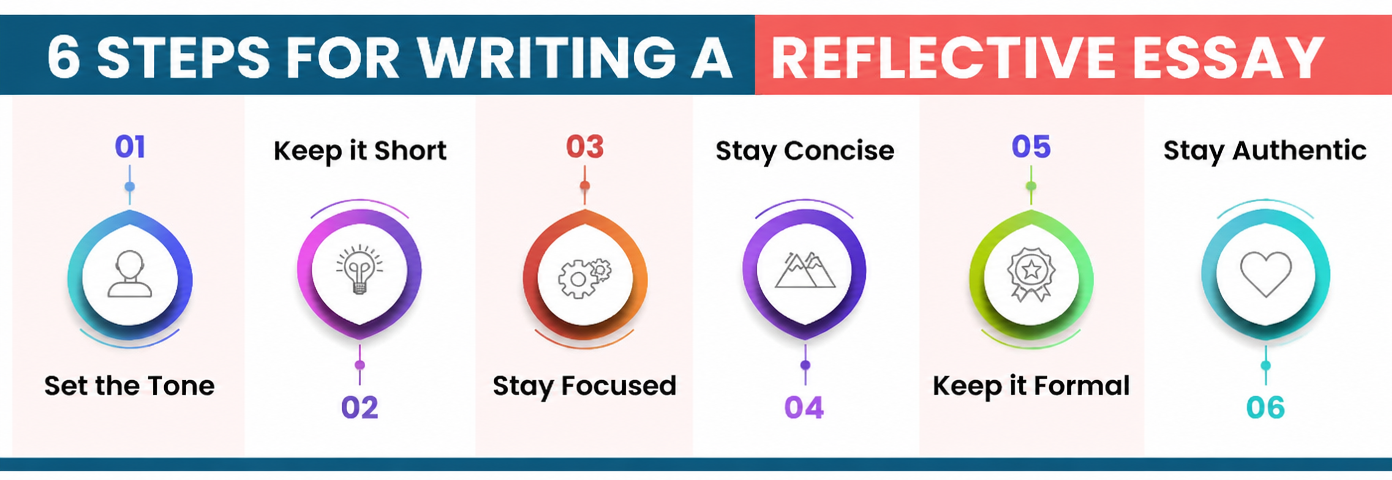
Writing a reflective essay not only requires you to describe an event; you have to go further and analyse what occurred, the importance of it, and how it will affect your future actions. There are six steps involved in writing your reflection.
Choose a Relevant Experience
Identify a particular instance when one of your assumptions was proved wrong, or when a personal weakness was exposed or a new skill learned. This may be a class project, some criticism received in class or any supervised work experience.
Describe What Happened
Give the necessary background and your part in it, as well as the results. This section should be kept brief, since the more stories you tell, the less space is left for analysis.
Analyse the Experience Critically
Explore the reasons behind how things went the way they did. Reflect on the decisions made, the assumptions made, the emotions involved, and the influences involved. Highlight what was done well, what could have been done better, and if you would have approached it differently had you known then what you know now.
Connect Your Experience to Academic Theory
Back up your reflection through research, theory, or professional advice. For instance, in case of ambiguous roles in group work, you may use credible research about teamwork to analyse the issue. Make sure that the source used supports or challenges your perspective and cite sources according to your institution's format.
Explain What You Learned
Describe how the experience helped shape your perspective. Do not say, “I learned the value of teamwork.” Rather, describe what you learned regarding communication, shared responsibility, or conflict resolution. Your learning should be the logical result of your analysis.
Create an Action Plan for the Future
Provide a plan as to how you will use your learning in a similar situation. For instance, you may choose to set yourself practical ways of doing this, like coming up with group roles early on, practicing presentations or seeking feedback before submission.
What Is the Correct Reflective Essay Structure and Format?
There is no universal structure for all reflective essays. The guidelines of your institution should be given priority, but a typical introduction, body and conclusion will help you get started.
Introduction - Provide an overview of the experience/issue that you will be reflecting upon. Explain its relevance to the essay. Highlight the core of your essay and mention the reflective model that you will employ, if any.
Do not try to describe the entire experience in the introduction. Rather, provide the readers with an idea of what you will be reflecting upon.
Main Body- The main body is where you will logically reflect upon the issue. According to your model and assignment guidelines, it could include:
Short description of the situation and your part in it.
Analysis of your thoughts, emotions, decisions and actions.
Analysis of the causes of the result.
Linking your observations with theoretical knowledge or evidence.
Discussion of what you learned and how your perception changed.
Every paragraph must add to the reflection process. You may structure the paragraphs according to the stages of either Gibbs or DIEP, but you don't have to make a separate heading for every stage unless it is required by the assignment.
Conclusion - Conclude with the key takeaways from your reflection. Elaborate on what you have learned through this process, how it changed your perception and what lessons you will take with you in the future.
Do not introduce any new arguments or retell the whole story again. The conclusion needs to demonstrate how the reflection has evolved from an experience into its meaning.
In terms of formatting, use the guidelines given in your assignment instructions regarding the number of words, line spacing, font type, etc. If there is no specific format stated in your assignment, ask your tutor instead of making assumptions about all universities having the same format guidelines.
What Does a Reflective Essay Example Look Like?
The examples below are illustrative scenarios, not accounts of verified student experiences. They demonstrate how reflection can connect an event with analysis, academic understanding and future action.
Academic Example: Reflecting on a Group Presentation
In a group presentation, I found it hard to answer questions regarding the research as I had focused only on memorising my part of the presentation and not on comprehending how my part linked with the entire research work. In the beginning, I thought that it was an issue of low confidence. But in retrospect, I came to know that my preparation was very limited. I had not practiced presenting our research findings in my own words.
This experience taught me the difference between remembering facts and actually applying them in a discussion. By relating this experience to the academic literature on learning and communication, I was able to determine the reasons for my poor preparation other than just being nervous. In the future, I will practice answering questions about the topic and talk with my group about our project prior the presentation.
Why this is effective: This example contains the experience, challenges the original reason for why it occurred, specifies what needs to be learned, and provides solutions. For an essay to be submitted, the academic aspect of it would have to be based on an actual source.
Nursing Placement Example: Reflecting on Patient Communication
In my nursing placement under supervision, I observed that one of the patients was reluctant to talk about any issues in his care. At first, I thought that the patient was not willing to communicate. But after analysing the situation and consulting with my supervisor, I thought that maybe I was asking questions too soon.
This reflection helped me analyse the way my communication affected the whole situation. Professional guidance and academic sources concerning patient-centred communication would be useful for my understanding of the issue. I made up my mind to spend more time on questions, ensure that the patient understood my explanations and receive feedback from my supervisor.
Why this is effective: The reflection examines my assumptions, explores other possibilities and finds ways to improve my future practice. When working in a clinical environment, I need to act according to my competence, professional guidelines and maintain confidentiality of patients.
Need a Nursing or Education Reflection Written Properly?
Work With a Writer Who Knows Your Course and Referencing Style
A reflective essay often contains your personal observations, but when you use theories, research results, or advice of professionals, citations are necessary. Quote the sources that influence your analysis and differentiate your understanding from those of other authors.
Harvard Citation Style usually employs the author and date style, but APA also uses the author and date style with its own unique guidelines for citations and references. These depend on which version of the guide one is using.
For instance, a sample citation following the general Harvard system may be made as Gibbs (1988), where that is the version you have consulted. The reference entry in your reference list will follow the format dictated by your institution.
Final Thoughts
All in all, learning how to write a reflective essay requires going beyond the experience and understanding what lies beneath it and what the experience means for your knowledge and growth. Choose a relevant experience; analyse it carefully; connect your analysis with reliable academic literature; find out how you are going to use what you've learnt.
The reflective model can be used as an aid for organising this process, but the importance lies more in your analysis rather than ticking off each heading in a set order. Prior to handing in your reflection, refer back to the assessment guidelines, sources and action plan.
Get an Extra 5% OFF On Your Order in Our App
Scan the QR code with your mobile to unlock an exclusive offer!
Yes. First-person pronouns are generally appropriate because you are examining your own experiences, thoughts and learning. However, keep the tone analytical and academic rather than writing as though you were keeping a casual diary.
How Long Should A Reflective Essay Be?
The required length depends on your assignment brief and university guidelines. Some reflections are short, while others require detailed analysis and academic references. Always follow the specified word count rather than relying on a universal rule.
Which Reflective Model Is Best For A University Essay?
It depends on your assignment. Gibbs provides six detailed stages, DIEP focuses on insight and future application, while Driscoll and Rolfe use three broad questions. Choose the model required by your module or best suited to the reflection.
Do Reflective Essays Need Academic References?
Many university reflective essays require academic references, particularly when you connect your experience with theories, research or professional standards. Check your assignment instructions and cite sources accurately using the referencing style required by your institution.
What Is The Difference Between Reflection And Description?
Description explains what happened. Reflection examines why it happened, what influenced your decisions, what the experience means and what you learned. Strong reflective writing uses description as context for deeper analysis rather than as the main focus.
Should A Reflective Essay Include An Action Plan?
An action plan is useful when you need to show how you will apply your learning in the future. Explain what you intend to change, which steps you will take and how you will assess your progress.
Choose a writer for your task among hundreds of professionals
Try Before You Buy !
Get Free PDF Link Directly to your WhatsApp!
Great!!Sumsa Free PDF Template has been delivered on your
WhatsApp Number.
Please rotate your device
We don't support landscape mode yet. Please go back to portrait mode for the best experience
We use cookies to ensure that we give you the best experience on our website. If you continue to use this site we will assume that you are happy with it. Know more



 Company














 Update your Number